
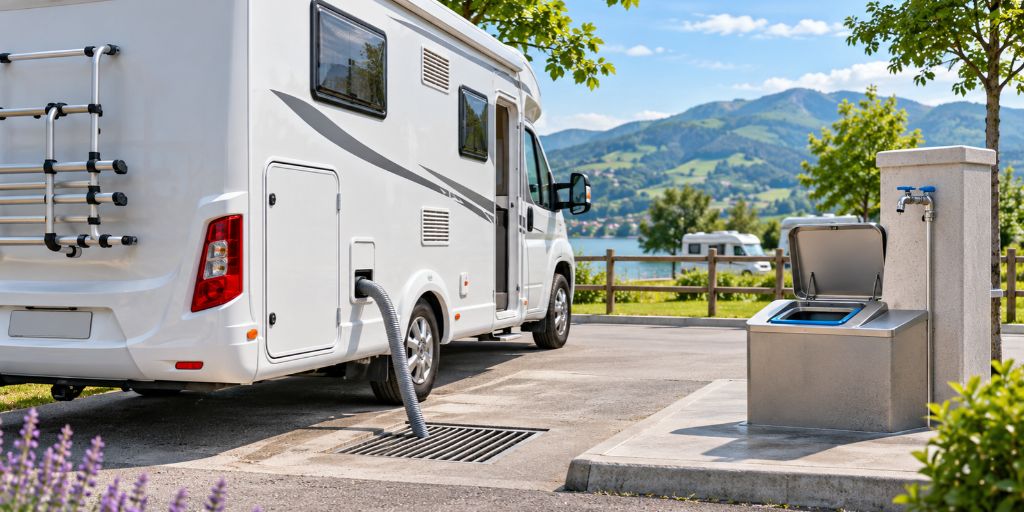
Travelling by motorhome gives you the freedom to discover new places, but it also means getting to grips with a few maintenance tasks. One of the most important is knowing where to empty grey and black water from a motorhome, how to do it properly and which places are set up for it.
Waste water must be emptied at motorhome service areas, campsites or petrol stations with dedicated facilities. It must never be poured into the street, onto open land or down drains that have not been specifically designated for the purpose.
In this guide, we explain how to tell the tanks apart, where to find disposal points near you and what to bear in mind so that you can travel responsibly.
What are grey water and black water in a motorhome?
Before looking for somewhere to empty your tanks, it is important to understand the difference between the types of waste water a motorhome produces.
Grey water: what is it and where does it come from?
Grey water in a motorhome is the water that comes from the shower, the washbasin and the kitchen sink.
Although it does not contain toilet waste, it can include soap, detergent, food scraps, grease and other substances.
This water is usually stored in a tank fitted underneath the vehicle. Its capacity depends on the model, but in many motorhomes it is roughly between 80 and 150 litres.
When the tank starts to fill up, you will need to find an authorised emptying point. It is best not to wait until it is completely full, especially if you are planning to drive for several more hours.
Black water: what is it and how is it stored?
Black water in a motorhome is the waste from the toilet, including organic matter and sewage.
In many motorhomes, this waste is collected in a removable tank known as the toilet cassette, which forms part of the chemical toilet.
Its capacity is usually smaller than that of the grey water tank, so it needs emptying more often.
Some models have a fixed black water tank instead. In that case, the emptying system may be different and you will need to use compatible facilities.
Understanding both systems is essential to avoid mistakes when maintaining your vehicle.
Where to empty grey and black water from a motorhome in Spain
Spain has a range of facilities designed to collect waste water from motorhomes and campervans.
The key is to check that the site offers the right service for each tank, as not every facility accepts both types of waste water.
1. Motorhome service areas
Motorhome service areas (known in Spain as areas de autocaravanas, much like the aires you find in France) are one of the best options for emptying your tanks.
They may be run by the local council or privately, and they usually have a drive-over platform with a drain for grey water and a separate point for black water.
Some also offer other services, such as drinking water, electric hook-up, parking or overnight stays.
Some areas are free, while others charge a fee to use their facilities. Before you go, it is worth checking the opening hours, access conditions and services available.
2. Campsites with a waste disposal point
Many campsites have facilities for emptying motorhome tanks.
They are particularly handy when you are on a trip lasting several days and want to make the most of the stop to have a shower, rest, fill up with water or use other facilities.
If you are not planning to stay, ask before you drive in. Some sites let you use the disposal point for a fee, while others keep it for their own guests.
3. Petrol stations and service stations
Some service stations have dedicated motorhome facilities.
These can be convenient on long road journeys, as they let you combine a fuel stop with emptying your tanks.
However, not every petrol station has a waste disposal point. It is advisable to check availability before changing your route.
4. Authorised private facilities
Some motorhome car parks, campervan areas and specialist businesses also offer waste disposal services.
In every case, check that the facility accepts the type of waste water you need to empty and follow the instructions given by the people who run it.
How to find where to empty grey and black water near you
One of the most common questions on the road is: where can I empty the grey and black water from my motorhome near where I am?
Fortunately, there are several tools that make the search easier.
Apps for finding disposal points
Platforms you can use include:
- Park4night: helps you find motorhome areas, campsites and other spots used by fellow travellers.
- Campercontact: provides information on motorhome areas and services in many different countries.
- CaraMaps: makes it easy to search for motorhome facilities and plan your route.
Before setting off, check the services listed for each location and read the latest reviews from other users.
It is important to check whether the point accepts grey water, black water or both, as this can vary.
Searching for disposal points on Google Maps
You can also use Google Maps with searches such as “grey water disposal near me”, “motorhome service area” or “motorhome black water disposal”. In Spain, it also helps to search in Spanish, for example “vaciado de aguas grises” or “area de autocaravanas”.
Look at the photos, reviews and business details. If in doubt, give them a call to confirm that the service is still running.
Recognising the disposal point sign
In Spain, the S-128 road sign marks emptying points for caravans and motorhomes.
Recognising it can help you find suitable facilities when you are driving through an unfamiliar area.
Either way, always check the instructions and services available on site.
How to empty the grey water from a motorhome, step by step
Emptying grey water is usually straightforward, but it is worth taking care to avoid spills.
Step 1. Find an authorised drain
Look for a grey water emptying area, usually a platform with a drainage grate set into the ground.
Check that the facility is in working order and that your vehicle can get in.
Step 2. Position your motorhome correctly
Line the tank outlet up over the drainage grate.
It is important to position the vehicle carefully, as the location of the grey water outlet varies from model to model.
Make sure the vehicle is parked safely before you start.
Step 3. Open the drain valve
Find the tank valve and open it following the manufacturer’s instructions.
Let the tank drain completely and check that the water is flowing into the designated drain.
Step 4. Clean the area and close the valve
Once you have finished, check that no waste has been left on the platform.
If necessary, and where permitted, use the rinsing water provided to wash down the area.
Finally, make sure the valve is properly closed before continuing your journey.
How to empty the black water from a motorhome toilet
Emptying black water calls for extra care for reasons of hygiene.
In motorhomes with a removable cassette, the usual procedure is as follows.
Step 1. Remove the toilet cassette
Open the external locker on the vehicle and take out the cassette following the manufacturer’s instructions.
Wear gloves and check that the cassette is properly closed to avoid spills.
Step 2. Find the black water disposal point
Head to a facility designed for emptying chemical toilets, often called a chemical disposal point (CDP) or Elsan point.
You will normally find a dedicated drain for this type of waste.
Do not use the grey water grate to empty the cassette unless the facility clearly states that it accepts both types of waste.
Step 3. Empty the contents
Open the cassette spout and pour the contents slowly into the drain.
If the cassette has an air-release button, use it as the manufacturer recommends to help the contents flow and reduce splashing.
Step 4. Rinse the cassette
Only use the tap provided for rinsing chemical toilets.
Never use the drinking water hose to rinse the cassette, as you could contaminate it.
Step 5. Get the cassette ready to use again
Once it is clean, add the amount of water and compatible toilet chemical recommended by the manufacturer, where applicable.
Close the cassette, check for leaks and refit it correctly.
Is it illegal to empty grey and black water in the street?
Waste water from a motorhome must not be emptied onto public roads or into the countryside.
Nor should you assume that an ordinary street drain is a suitable place to empty your tanks.
Even though grey water comes from a shower or sink, it can contain pollutants.
Discharging waste water anywhere other than an authorised facility may breach local by-laws and environmental regulations, and can lead to fines depending on the circumstances.
Spain’s Directorate-General for Traffic (DGT) also draws a distinction between parking correctly and activities that go beyond parking, such as discharging fluids.
So the advice is clear: always use facilities that are designed and authorised for handling waste water.
How often do you need to empty grey and black water?
How often you need to empty your tanks depends mainly on their capacity, the number of people travelling and how much water you use.
As a rough guide, a couple may need to empty the grey water every two or three days, or sooner if they use the shower and sink a lot.
As for black water, a small cassette may also need emptying every two or three days.
These figures are only a guide: how long you can actually go between emptying can vary considerably.
Does the time of year make a difference?
In the summer months it is particularly important not to leave waste sitting in the tanks for long, as high temperatures encourage unpleasant smells.
The most practical approach is to make use of the authorised points you come across along your route, without waiting until your tanks are completely full.
Tips for keeping your motorhome tanks in good condition
Proper maintenance makes travelling more comfortable, helps prevent unpleasant odours and reduces the risk of breakdowns.
To look after your grey and black water tanks, follow these recommendations:
- Empty the tanks regularly and never overfill them.
- Avoid putting food scraps, oil or grease down the sink.
- Use cleaning products that are compatible with your motorhome’s systems.
- Check valves, seals and connections regularly.
- Keep the emptying systems clean.
- Do not use chemicals that are prohibited by the manufacturer or by waste treatment facilities.
It is also a good idea to check the condition of your tanks before setting off on a long trip.
Frequently asked questions about emptying motorhome waste water
Where can I dispose of grey water from a motorhome?
Grey water should be emptied at designated areas such as motorhome service areas, campsites and certain service stations. This is usually done over a drainage grate on a platform designed for these vehicles.
Where should I empty the black water from a motorhome?
Black water must be emptied at points designed for sewage or chemical toilet waste. In motorhomes with a removable cassette, a conventional toilet may also be used, provided it is compatible with the system, it is permitted and it can be done hygienically.
Can I empty grey water down a street drain?
A street drain should not be used as a disposal point. Even if it appears to be connected to the sewers, that does not mean it is authorised to receive waste water from motorhomes.
Is it free to empty motorhome tanks?
It depends on the site. There are free council-run areas, as well as facilities that charge for emptying, fresh water or access to their services. It is best to check the conditions before you go.
Can I empty black and grey water in the same place?
Yes, a single service area may have facilities for both. However, each tank must be emptied into the correct drain, following the instructions on site.
What happens if I don’t empty the grey water tank?
If the tank reaches full capacity, the shower, washbasin or sink may struggle to drain. Leaving waste in the tank for too long can also cause unpleasant smells.
Travel by motorhome with Horizon CHM and enjoy the freedom to explore new places
Knowing where to empty grey and black water from a motorhome is essential for a comfortable, responsible trip.
Planning your stops, finding service areas and looking after your tanks properly will leave you more time to discover new places.
At Horizon CHM, we want you to enjoy every getaway with complete peace of mind, whether you are planning your first adventure or are already an experienced motorhomer.
More guides to help you plan your stops
If you are planning a route through Andalusia, you can also read our guide to the best motorhome areas in Malaga (in Spanish) to help you decide where to stop.
And if you are ready for your next adventure on the road, explore the Horizon CHM motorhome range and start planning your trip.
Have any questions about emptying your tanks or looking after your motorhome? Drop us a line or give us a call – we will be happy to help you plan everything.